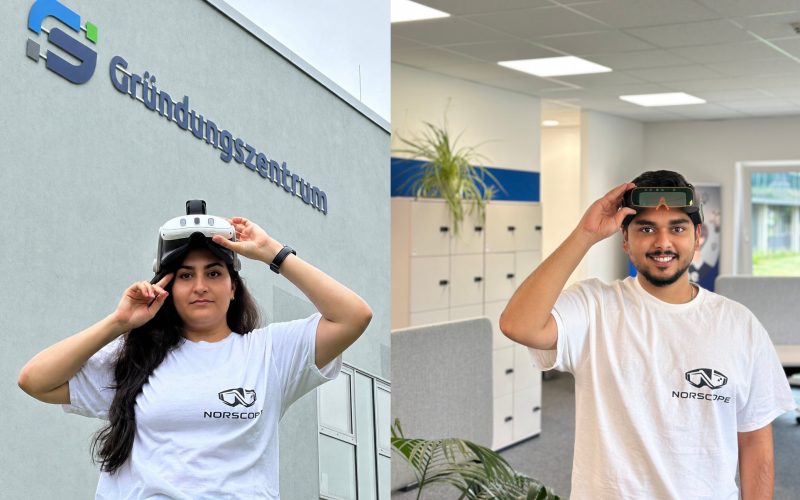
Eighteen teams applied for the fourth edition of the ideas competition. Eight particularly impressed the organisers and presented their ideas in short pitches at the final in the Startup Centre in early March.
‘We are delighted to announce that all three winning teams from the 2023 TUniCorn ideas competition have successfully founded companies. That shows the great startup potential of our region,’ said Simon Wolters, opening the final of the 2026 TUniCorn ideas competition in early March together with Selma Lohan. Both are advisers in the joint startup service run by TU Clausthal and WiReGo. A new participation record was set this year: 18 teams applied for the fourth edition of the competition. Eight of them particularly impressed and were allowed to present their ideas in short pitches at the final at the Startup Centre on 05 March.
The competition is highly significant for the founding teams. Statements by past and current participants make this clear. All teams value the honest, clear external assessment of their business ideas from the jury members. It reveals weaknesses in their concepts, sharpens their target groups and helps develop their business models substantially with an eye to commercial viability.
Quality of entries impresses jury
After their pitches, the finalists answered questions from the jury. As in the previous year, it comprised Iris Seeber (Volksbank im Harz), Christian Schäfer (Fels-Werke GmbH), Dr.-Ing. Michael Reiß (Holos Excellence) and Samet Kibar (Clausthal-Zellerfeld Startup Centre). Prof. Ani Melkonyan-Gottschalk also participated online for the first time and was represented on site by Annika Hoppe (both from the Institute of Geotechnology and Mineral Resources).
‘Their ideas challenged me in a particularly rewarding way this year. I really enjoyed exploring the topics presented,’ Iris Seeber said in praise of the pitches. Christian Schäfer also stressed: ‘Every project was extremely interesting and professionally presented.’ The jury assessed the teams on innovation potential, customer benefit and presentation.
Innovative approaches to energy, recycling and communication
First place went to Dr.-Ing. Marina Becker and Dr.-Ing. Maik Becker for ‘QuinAir’, a seasonal electrochemical energy storage system combining redox flow and metal-air batteries. The novel air redox flow battery aims for extremely low costs (less than €34/kWh), high energy density and seasonal storage of solar power. They receive €1,000 in prize money for first place.
Second place, worth €500, went to the ‘Rotor’ project. Maximilian Feyrer and Philipp von Güldenstubbe are developing a continuous pyrolysis process for material recycling of glass-fibre-reinforced plastic rotor blades from wind turbines. The aim is to recover glass fibres as well as oil and gas fractions from real, heterogeneous rotor blade materials, establishing a genuine recycling route instead of downcycling as in the cement industry.
Zaki Hussein, Dominik Schulz and Dr. David Unbehaun took third place with ‘Clara AI’ and receive €250 in prize money. ‘Clara AI’ is a hands-free, natural-language AI system that enables nursing staff to document care directly while they work. Spoken content is transcribed, analysed semantically, structured and transferred to care software in accordance with guidelines. Its distinctive features are multilingual capability and the ability to answer staff questions about individual patients.
Further support for the finalist teams
Before the awards ceremony, Emil Alkountar, founder of the perfume brand ‘Or et Vin’, gave a keynote about the transition from idea to startup, drawing on his own journey. ‘There is never a perfect plan. Even if the start is bumpy, just begin!’ he told the participants.
The jury is convinced of all the teams’ potential and is therefore offering further support after the competition. In around six months, jury members would like to learn how the projects have developed. The joint startup service will organise this follow-up format.
There will be another TUniCorn ideas competition in 2027. TU Clausthal students and staff, committed innovators from companies, and founders from the region (natural persons) can participate.