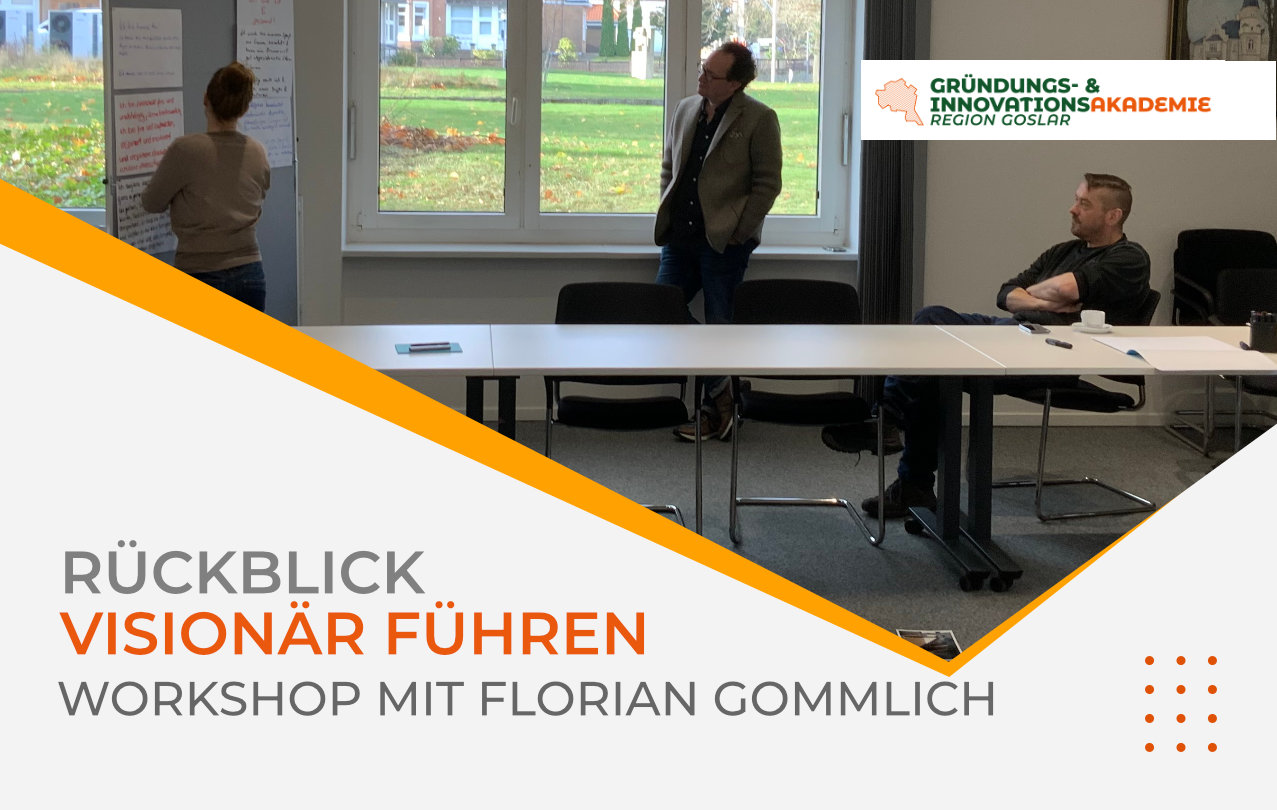
On 18 and 19 November 2025, aspiring founders and managers from the region came together for a two-day intensive WiReGo seminar. This time, the focus was on a topic often neglected in everyday life: one’s own vision. Confidence, purpose and the power of strong mental images can create the greatest impact.
Coach Florian Gommlich’s workshop centered on three questions:
- What creates genuine leadership?
- How do visions work when they truly reach people?
- And what values sustain us when things get difficult, forming the basis for an effective mission?
Participants learned that leadership is, at its core, an exchange: employees offer performance and commitment, while leaders provide security, clarity and direction. This ‘inner security’ comes not from techniques but, from a neurobiological perspective, from Inner Status: six factors that primates have used for millennia to establish rank and trust. They include personal values, focus, the handling of emotions and competence.
As a leader, you need to meet employees’ expectations of competence and confidence in them, just as a company must meet its customers’ expectations. The same principle applies.
During these two days, participants deliberately worked on using strong mental images as a key to energy, identification and leadership impact.
Florian Gommlich vividly showed why images have a faster effect than language: they activate the limbic system, calm the amygdala (‘Am I safe?’) and release dopamine – the neurochemical system that drives and connects us.
Participants therefore worked with three visual methods:
- Selecting powerful image cards to symbolize a possible future
- Painting their own ideal states and
- Telling a ‘campfire scene’ set in 2030 – imagining that their desired future had already become reality.
Everyone thus developed an initial vision with emotional force: an image of the future that inspired them to think bigger and act more boldly.
Next, participants worked on their personal values. Starting from Aristotle’s cardinal virtues, they developed individual maps of values to serve as ‘behavioral filters.’ They then translated these values into a mission: a clear, action-oriented statement in the present tense describing how they want to behave to move step by step toward their vision.
These missions were expressed in surprisingly concrete, relatable and powerful terms. They show that when vision (Why?), mission (How?) and values come together, leadership and customer trust can emerge because the whole approach feels coherent from within. At the same time, a personal mission acts as a guide for self-leadership, which mattered to many seminar participants.
Finally, the group explored how to embed a team or company vision and mission in everyday work. Practice suggests that these become part of a shared identity only when they are developed and upheld together. Participants received practical tools, facilitation principles and clarity about their role – as a source of ideas, a setter of the framework and a member of their own team.
Conclusion:
Two days that inspired, challenged and connected people.
And two days that showed how much people thrive when they engage with purpose, mental images and values – and begin not just to exercise leadership but to embody it.
A few inspiring insights »