How companies can profitably implement the circular economy
Dr.-Ing. Phillip Wallat offers long-term solutions for production and recycling through DfACE
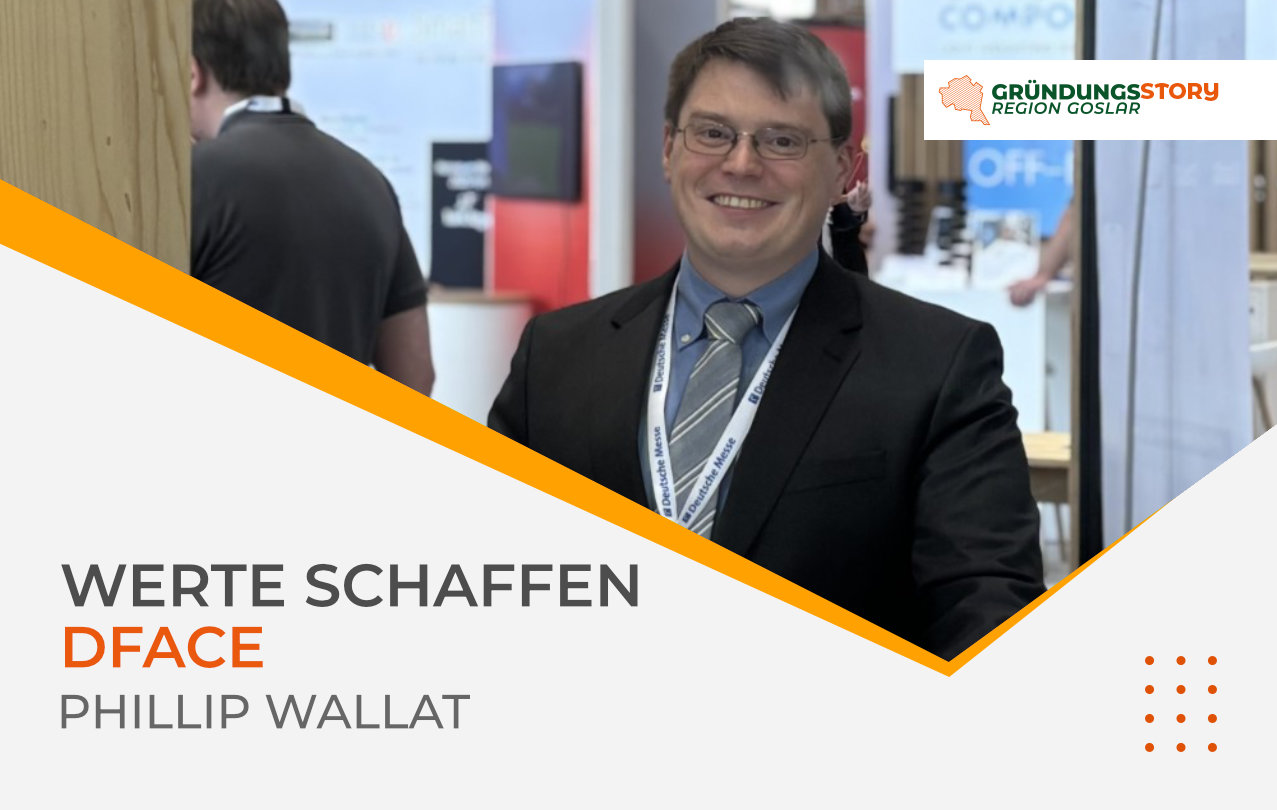
When 36-year-old founder Dr.-Ing. Phillip Wallat talks about his vision, it becomes clear that his profession is his calling. Since 2024, he has used DfACE to advise companies on improving resource efficiency, not only in our region but worldwide. He wants to use clear facts to show manufacturers that long-term planning will give them a competitive advantage tomorrow. At the same time, he wants to encourage cooperation between manufacturers and recycling companies so materials can be reused efficiently and reliably. His goal is a sensible, economically viable and future-ready transition to a functioning circular economy.
A success story for TU Clausthal and the region
Wallat’s career is a prime example of the opportunities offered by TU Clausthal and the Goslar region. Originally from Bremerhaven, the young entrepreneur has been at the university since October 2013. He completed bachelor’s, master’s and doctoral degrees while working as a research associate at the Institute of Mechanical Engineering (IMW). He encountered the circular economy through an international project at the institute, which laid the foundation for his mechanical engineering dissertation. A grant under Lower Saxony’s High-Tech Incubators (HTI) program provided initial financing to implement his business idea immediately after his time at the university.
‘I actually wanted to start slowly,’ Phillip Wallat says with a laugh. ‘But the funding allowed me to become fully self-employed straight away.’ Alongside all the enthusiasm and support, it took considerable self-discipline and motivation to make a successful start in entrepreneurship.
The founder is supported by two working students from Malaysia and Indonesia. He had worked with both at TU Clausthal and saw them as the ideal people for the roles. ‘That’s the advantage of a small international university,’ Wallat emphasizes. ‘You meet people from all over the world and build a strong network.’
For him, the Goslar region is a clear location advantage because, as a founder, he finds ‘doors already open.’ WiReGo’s events enriched him both for their content and the contacts they created. He has strong partners in the employers’ association and REWIMET e.V. As a young entrepreneur, he wants to use the region’s opportunities to work together.
The circular economy as a long-term competitive advantage
Phillip Wallat offers his complex knowledge of mechanical and industrial engineering in various modules. He looks for ways to optimize designs and improve production processes, taking existing recycling technologies into account, among other things. Sometimes changing the mix of materials is enough to make recycling easier without significantly limiting a product’s performance. In the long run, these measures increase companies’ competitive advantage.
The founder looks back with satisfaction on his first year of self-employment: ‘After a while, you realize you’re helping shape the region and creating lasting value. That makes the work enjoyable.’
Information at: dface.eu